
Springer Nature Book Chapter Call: Cancer Immunotherapy 2026
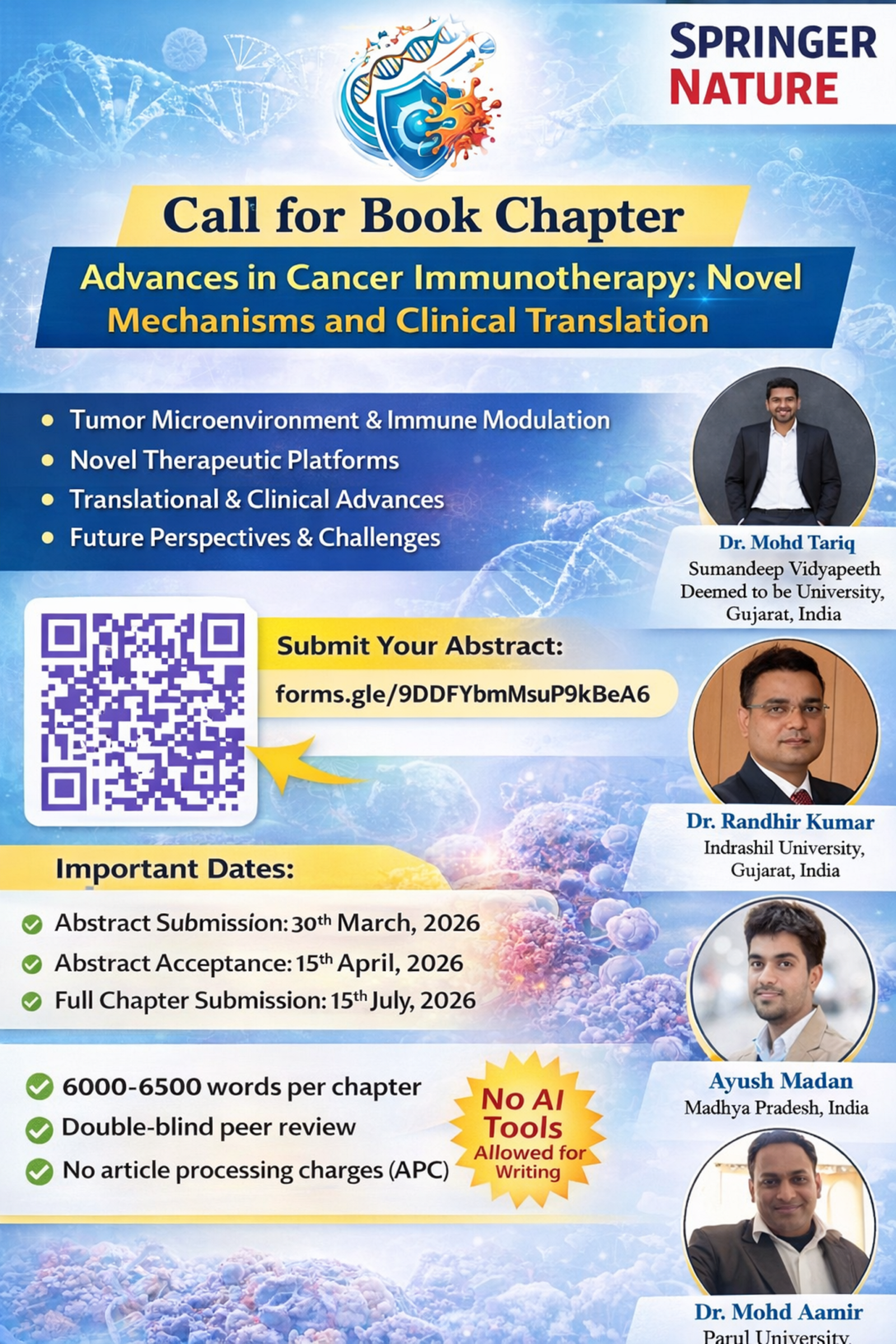
Are you a researcher, clinician, or academician working in the field of cancer immunotherapy? Here is a prestigious opportunity you cannot afford to miss. A Springer Nature book chapter call has been announced for the upcoming volume titled “Advances in Cancer Immunotherapy: Novel Mechanisms and Clinical Translation.” If your work touches on tumor microenvironments, novel therapeutic platforms, translational oncology, or the future of immune-based cancer treatments, this is your platform to contribute to a globally recognized scientific publication — with no article processing charges.
What Is This Springer Nature Book Chapter Opportunity?
Springer Nature, one of the world’s most respected academic publishing houses, is inviting researchers to submit book chapters for a new edited volume focused on cutting-edge developments in cancer immunotherapy. The book is being compiled by a distinguished editorial team comprising experts from leading Indian universities:Dr. Mohd Tariq – Sumandeep Vidyapeeth Deemed to be University, Gujarat, IndiaDr. Randhir Kumar – Indrashil University, Gujarat, IndiaAyush Madan – People’s University, Madhya Pradesh, IndiaDr. Mohd Aamir – Parul University, Gujarat, IndiaThis edited volume will serve as a comprehensive reference for scientists, oncologists, immunologists, and postgraduate students worldwide. Getting published in a Springer Nature book is a significant academic achievement that enhances your research profile and contributes to the global body of knowledge in oncology.
Book Title and Scope
Book Title: Advances in Cancer Immunotherapy: Novel Mechanisms and Clinical Translation Publisher: Springer Nature
The scope of this volume is broad yet focused, covering both fundamental mechanisms and their clinical application. Contributions are invited under four clearly defined sections, ensuring that diverse research perspectives — from the molecular to the bedside — are represented.
Chapter Topics: What Can You Write About?
The book is organized into four thematic sections, each addressing a critical dimension of modern cancer immunotherapy research.
Section I: Tumor Microenvironment and Immune Modulation
The first section explores the complex ecosystem within and around tumors that influences immune response. Accepted chapter topics include:
- Spatial Immunology: Decoding the Tumor Niche for Therapeutic Targeting – An in-depth look at how spatial organization of immune cells within tumors affects therapeutic outcomes.
- Metabolic Cross-Talk in Cancer Immunity: Pathways and Therapeutic Interventions – Examines how metabolic interactions between cancer cells and immune cells shape the immunosuppressive tumor microenvironment.
- Next-Generation Immune Engineering: Beyond CAR-T Cells – Explores innovations in adoptive cell therapy beyond conventional CAR-T approaches, including TCR-T cells, NK cell therapies, and more.
- Engineered Bacteria as Precision Delivery Systems for Immunotherapy – A novel frontier discussing how genetically engineered bacteria can be used to deliver immunotherapeutic agents directly to tumors.
Section II: Novel Therapeutic Platforms
This section invites chapters on emerging immunotherapeutic technologies:
- Multispecific Antibodies in Oncology: Design, Mechanisms, and Clinical Progress – Covers the development and clinical translation of bispecific and trispecific antibodies.
- Noncoding RNAs as Immunomodulators: From Mechanisms to Therapies – Investigates the role of lncRNAs, miRNAs, and circRNAs in regulating immune function in cancer.
- Virus-Like Particles (VLPs) in Cancer Immunotherapy: Vaccines and Beyond – A rising area where VLPs are leveraged as antigen delivery platforms for cancer vaccines.
Section III: Translational and Clinical Advances
Bridging laboratory discoveries with patient care:
- Tissue-Agnostic Immunotherapy: Expanding Treatment Beyond Tumor Types – Addresses immunotherapies that work based on molecular markers rather than tissue of origin.
- Overcoming Resistance to Immunotherapy in Refractory Cancers – Examines the mechanisms of immune resistance and strategies to overcome them in hard-to-treat cancers.
- Next-Generation Cell Therapies: Innovations and Clinical Prospects – Covers iPSC-derived cell therapies, in-vivo gene editing for immune cells, and clinical trial updates.
Section IV: Future Perspectives and Challenges
Looking ahead in cancer immunotherapy:
- Personalized Neoantigen Vaccines: From Bench to Bedside – Reviews the science and logistics of developing individualized cancer vaccines based on tumor-specific mutations.
- Biomarkers for Predicting Response to Cancer Immunotherapy – Discusses predictive biomarkers like PD-L1 expression, TMB, MSI, and emerging liquid biopsy tools.
- Navigating Regulatory and Commercial Challenges in Immunotherapy Development – A vital chapter on the path from research to market in the immunotherapy space.
Important Dates — Don’t Miss These Deadlines
Time is critical for this cancer immunotherapy book chapter submission. Here are the key dates you must mark on your calendar:
| Milestone | Date |
|---|---|
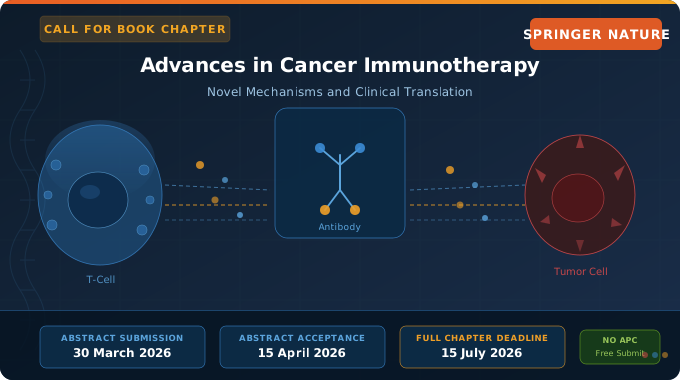
| Abstract Submission Deadline | 30th March 2026 |
| Abstract Acceptance Notification | 15th April 2026 |
| Full Chapter Submission Deadline | 15th July 2026 |
Given that abstract submissions close on 30th March 2026, researchers need to act immediately. Prepare a concise, well-structured abstract and submit it via the official Google Form linked below.
Submission Guidelines and Requirements
Before submitting, ensure your chapter meets the following requirements:
- Word Count: 6,000 – 6,500 words
- Co-authors: List all co-authors with complete information and links to their Google Scholar profiles
- Article Processing Charges (APC): None — this is a free-to-submit opportunity
- Peer Review Process: All submitted chapters undergo a rigorous double double-blind peer review process to ensure academic quality and integrity
- AI Policy: The use of any Artificial Intelligence software to write the text is strictly prohibited. All content must be original and authored entirely by the submitting researchers.
These guidelines reflect Springer Nature’s commitment to maintaining the highest standards of academic publishing.
How to Submit Your Chapter
Submission is straightforward and managed through a Google Form. Follow these steps:
- Prepare a structured abstract of your proposed chapter
- Ensure all co-authors are listed with their institutional affiliations and Google Scholar profile links
- Submit via the official form: https://forms.gle/9DDFYbmMsuP9kBeA6
- Wait for the acceptance notification by 15th April 2026
- Upon acceptance, prepare and submit the full chapter by 15th July 2026
Why Publish With Springer Nature?
Springer Nature is not just any publisher — it is one of the most prestigious names in global academic and scientific publishing. Here is why contributing to this Springer Nature publication is a career-defining move:
- Global Reach: Springer Nature books are indexed and accessible through thousands of libraries and research databases worldwide
- Citation Impact: Chapters in Springer Nature volumes receive significant citations, boosting your h-index and academic visibility
- Credibility: Association with Springer Nature signals quality and rigor to grant agencies, promotion committees, and international collaborators
- Interdisciplinary Exposure: Your chapter on cancer immunotherapy will be read by oncologists, immunologists, biochemists, and clinical researchers globally
- Open Access Options: Springer Nature offers flexible publishing options to maximize the reach of your work
For researchers in India and across South Asia, this is a rare opportunity to contribute to an internationally recognized edited volume without any financial burden, given there are no article processing charges.
Who Should Apply?
This call for book chapters in cancer immunotherapy is open to:
- PhD Scholars and Postdoctoral Researchers working in oncology, immunology, molecular biology, or related fields
- Faculty Members and Principal Investigators looking to expand their publication portfolio with book chapters
- Clinicians and Translational Researchers involved in cancer treatment and clinical trials
- Biomedical Scientists with expertise in drug delivery, gene therapy, or bioinformatics applied to cancer
Whether you are an experienced researcher or a young investigator with a fresh perspective, this is your chance to leave a mark in the rapidly evolving landscape of cancer immunology and immunotherapy.
Tips for Writing a Strong Book Chapter
Writing a book chapter differs from writing a journal article. Here are a few tips to make your submission stand out in the cancer immunotherapy book chapter review process:
- Start with a comprehensive introduction that establishes the topic’s significance and places your chapter within the broader context of the field
- Use clear subheadings to organize content logically — reviewers and readers appreciate a well-structured narrative
- Cite recent and seminal literature to demonstrate a thorough understanding of the field
- Include figures, tables, and diagrams where appropriate to enhance clarity and visual appeal
- End with a forward-looking conclusion that highlights open questions and future directions
- Adhere strictly to the word limit of 6,000–6,500 words to show respect for the editorial guidelines
- Avoid AI-generated content entirely — Springer Nature and the editorial board have zero tolerance for AI-written text, and human originality is mandatory
For guidance on writing high-quality academic manuscripts, you may also explore resources from the Springer Nature Author Academy or Editage Insights, both of which offer practical advice on academic writing and publication ethics.
Conclusion
The Springer Nature book chapter call for Advances in Cancer Immunotherapy: Novel Mechanisms and Clinical Translation is a golden opportunity for researchers dedicated to fighting cancer through immunological innovation. With no publication fees, a structured peer review process, and editorial guidance from experienced academicians, this platform offers everything needed to showcase your work at the highest level.
Whether your expertise lies in tumor microenvironment biology, engineered cell therapies, neoantigen vaccine design, or the clinical translation of immunotherapeutic agents, there is a chapter topic that aligns with your research. The abstract submission deadline is 30th March 2026, which means there is little time to wait.
Take this step toward international recognition. Submit your abstract today at https://forms.gle/9DDFYbmMsuP9kBeA6 and become part of a landmark publication with Springer Nature.
Discover more from dailyfirst
Subscribe to get the latest posts sent to your email.