
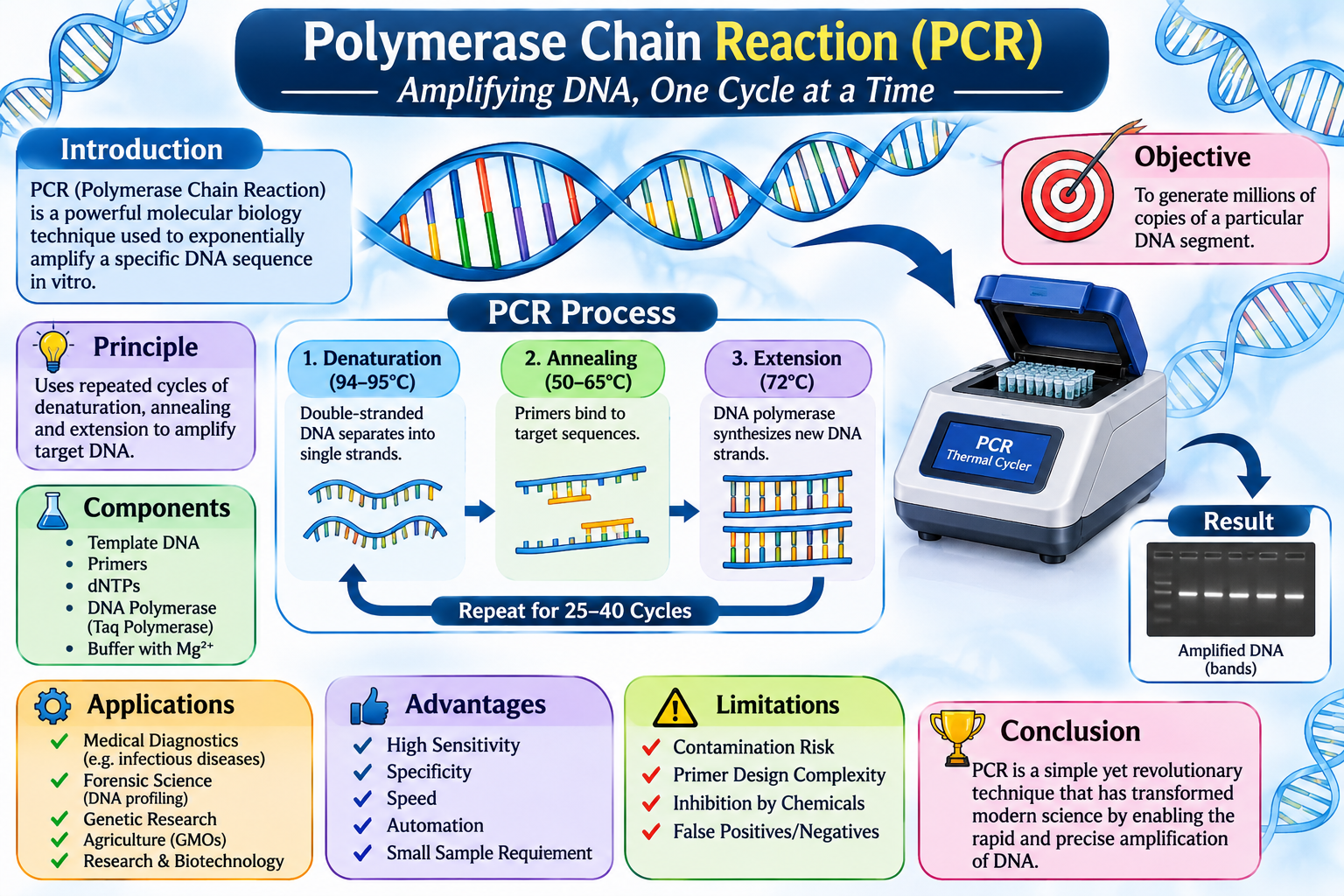
Polymerase Chain Reaction (PCR) is a laboratory technique that makes millions of copies of a chosen DNA segment in a few hours. It was developed by Kary Mullis in the 1980s and is a key topic in Biotechnology: Principles and Processes.
Requirements
- Template DNA containing the target segment
- Two short primers (forward and reverse)
- Taq polymerase, a heat-stable enzyme from Thermus aquaticus
- Free nucleotides (dNTPs), buffer and magnesium ions
- A thermal cycler, which changes the temperature automatically
The three steps of each cycle
- Denaturation (about 94 °C): the double-stranded DNA separates into two single strands.
- Annealing (about 50–60 °C): the primers bind to the complementary ends of the target.
- Extension (about 72 °C): Taq polymerase adds nucleotides and builds the new strands.
The cycle is repeated 25 to 35 times. The amount of DNA doubles each cycle, so after n cycles you get about 2n copies.
Applications
- Early detection of infections such as HIV and tuberculosis, and of genetic disorders
- Detection of mutations in cancer
- DNA fingerprinting in forensics
- Gene cloning and research
Exam tips
- Remember why Taq polymerase is used: it does not break down at high temperature.
- Learn the order: denaturation, annealing, extension.
- Draw a neat cycle diagram showing the strands doubling.
For a full project with diagrams, tables and viva questions, see our PCR Class 12 Biology Project PDF.
Discover more from dailyfirst
Subscribe to get the latest posts sent to your email.