
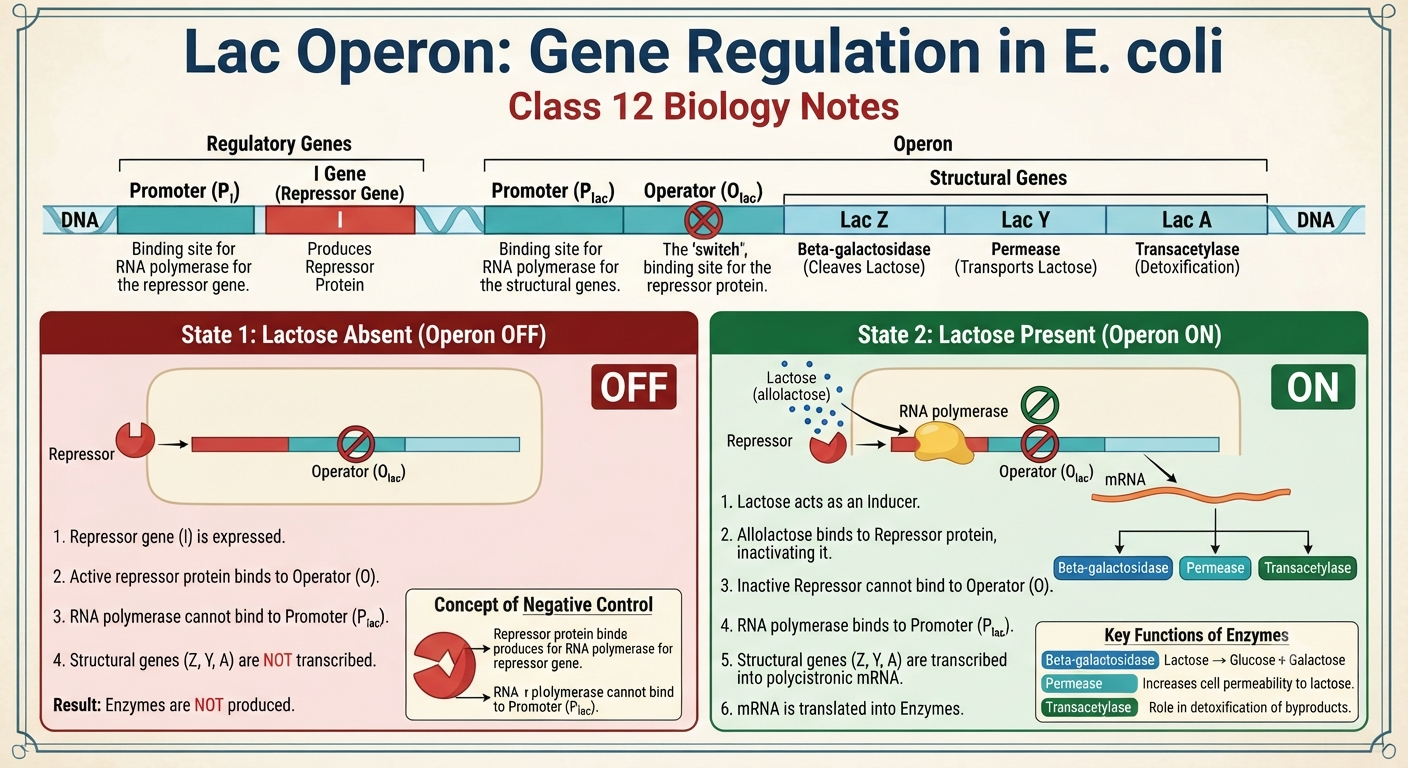
The lac operon of E. coli is one of the most important topics in Molecular Basis of Inheritance. It shows how bacteria switch genes ON only when they are needed. It was proposed by François Jacob and Jacques Monod in 1961.
Structure of the lac operon
- Regulator gene (lacI): codes for the repressor protein.
- Promoter (P): where RNA polymerase binds.
- Operator (O): where the repressor binds.
- lacZ: codes for β-galactosidase, which splits lactose into glucose and galactose.
- lacY: codes for permease, which carries lactose into the cell.
- lacA: codes for transacetylase.
Working
Without lactose: the repressor binds the operator, so RNA polymerase cannot transcribe the structural genes. The operon is OFF.
With lactose: lactose (as allolactose) acts as the inducer. It binds the repressor and changes its shape, so the repressor leaves the operator. RNA polymerase transcribes lacZ, lacY and lacA, and the enzymes are made. The operon is ON.
Why it is called an inducible, negatively controlled operon
It is normally OFF and is switched ON by an inducer, so it is inducible. The repressor blocks transcription, so the control is negative.
Glucose and CAP-cAMP
Even with lactose, the cell prefers glucose. When glucose is high, cAMP is low and CAP cannot boost transcription. When glucose is low, cAMP rises and CAP-cAMP increases transcription. The operon is fully ON only when lactose is present and glucose is absent.
Exam tips
- Draw the operon twice: without lactose and with lactose.
- Label promoter, operator, structural genes, repressor and inducer.
- Remember: the repressor binds the operator, not the promoter.
For a full project with diagrams, tables and viva questions, see our Gene Regulation Class 12 Biology Project PDF.
Discover more from dailyfirst
Subscribe to get the latest posts sent to your email.